Harry of Table Bay
The man who met the Dutch on the beach and was never quite who they thought he was.
By C.M. O'Neill
When the Dutch dropped anchor beneath Table Mountain in 1652, they were not landing among strangers. Ships had been stopping at the Cape of Good Hope or Cabo De Esparanza for years, and the Dutch had traded with the Khoi people who lived there long before they decided to stay.
One man at the Cape already knew the Europeans better than most. His name was Autshumao. Years earlier, English sailors had taken him aboard their ships and carried him far across the sea, as far as Madagascar. They called him Harry, and he grew so fond of the name, and of the English, that he used it himself ever after.
But Autshumao was not a powerful chief. He led only a small, poor band who lived by gathering food along the shore, and other Khoi groups around the bay distrusted him. So, when the Dutch built their fort, Harry saw both shelter and opportunity. He could speak their languages when almost no one else could, so they made him their interpreter. He ate at the commander's table, and under their protection was safe from those who wished him harm.
The Dutch did not raise their own cattle yet. They traded for them, handing over copper, tobacco and beads to other Khoi groups who brought herds down to the fort. And it was those cattle that Harry wanted most. In this world, a herd of cattle meant wealth, and wealth meant power and respect.
In October 1653, Autshumao and his followers chose their moment. It was raining, and the Dutch were all gathered at their church service, unable to keep proper watch. The raiders drove off nearly the whole of the herd. David Jansz, the young herder boy left in the field, was murdered. By the time the service ended, and the Dutch realised what had happened, Harry was long gone into the interior.
Then, sometime later, he simply came back, and the commander, Jan van Riebeeck, let him settle at the Cape again. He was never tried for the stolen cattle and never answered for the boy's murder. Why would they let it go? Because they needed an interpreter far too badly to turn him away.
Years later, in 1658, after fresh quarrels, Van Riebeeck finally banished Autshumao to Robben Island, the windswept rock out in the bay, and the first time anyone was ever sent there as a prisoner. But it was banishment, not a locked cell. The men had to find their own food and were largely left to themselves.
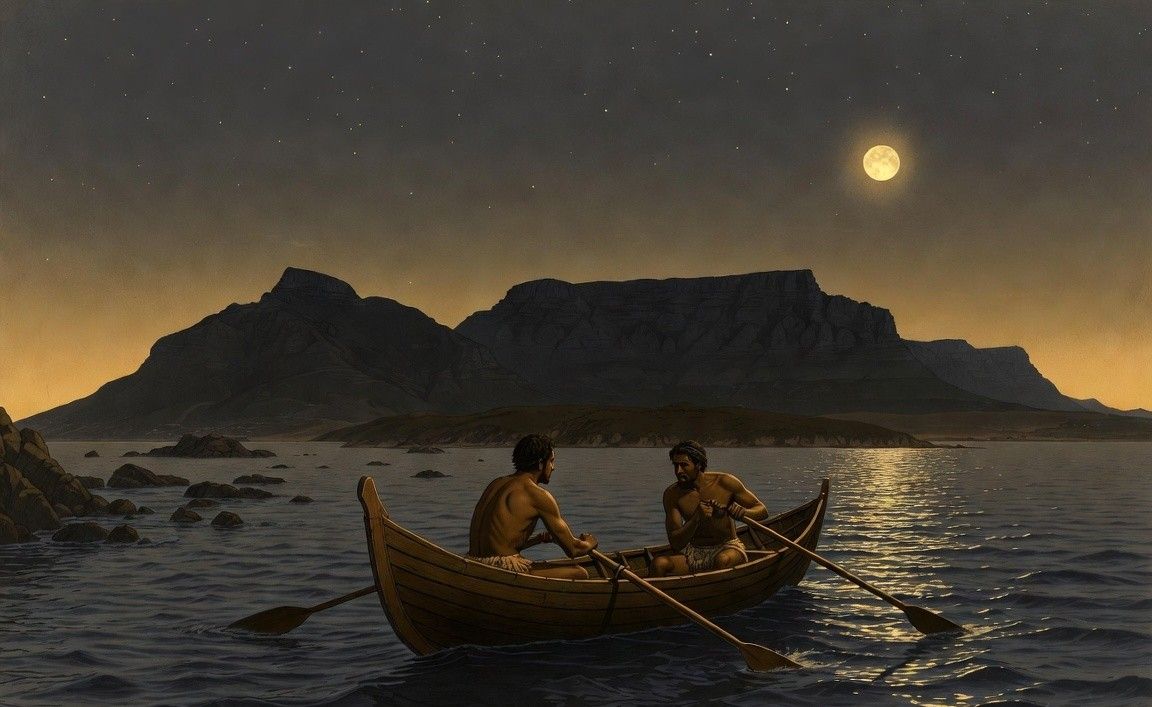
Late the next year, Autshumao and a companion stole the island's boat and rowed back to the mainland. They are the only people ever to escape from Robben Island.
For a while everyone assumed he had drowned. Then a message arrived from Autshumao himself, asking to come back and live near the settlement. The Dutch agreed. As they had for years, they still needed the one man who could speak to everyone, and before long he was working as their interpreter again. He died a few years later, around 1663.
So, the next time someone tells the story of the Cape as if the Dutch simply arrived and took charge of an empty land, remember the man who was already standing on the beach to meet them. He interpreted for them, ate at their table, emptied their cattle pens, talked his way back into their good books, and broke out of their island prison. The settlers wrote most of the history books. But Autshumao made sure he wasn't left out of the story.
A note for the curious
Historians don't fully agree about Autshumao. Some old accounts describe him simply as a cattle thief. Others see him as a clever survivor defending his people's herds and land. The Dutch records and the modern museums on Robben Island tell the story with their sympathies pointed in different directions, and even his date of death is uncertain. Most sources say around 1663, though a few say later. What the record does establish is the sequence of events: he interpreted for the Dutch, he led the raid that killed David Jansz and took the cattle, he was banished to Robben Island, and he escaped. How those acts are judged has always depended on who is telling the story.