The Cattle Charge
The most celebrated soldier of his age came ashore to punish the Cape. He did not leave the beach.
By C.M. O'Neill
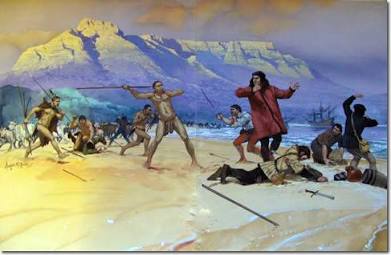
When Francisco de Almeida anchored beneath Table Mountain in the autumn of 1510, he was on his way home. Behind him lay five years as the first Viceroy of Portuguese India, the victory at Diu, and a reputation as the man who had turned the Indian Ocean into a Portuguese sea. Ahead lay Lisbon and a king's welcome. The Cape was only a place to take on fresh water, a brief stop between the fighting and the reward.
The people who lived there were the ǃUriǁʼaekua, a clan of the Khoikhoi who measured their wealth in cattle. European ships had been calling at the Cape for years to barter for water and meat.
Trade began cautiously and civilly, iron and trinkets passing one way and cattle the other. It ended when a party of Portuguese sailors walked up to a village. The accounts disagree about what happened next — a theft, a dispute over goods, or an attempt to seize cattle by force — but they agree on the result. The sailors returned to the ships bruised and humiliated, demanding that the village be punished.
Almeida was reluctant. He had crossed half the world and buried a son along the way, and he suspected, more clearly than his men did, that his own sailors had provoked the trouble. But a commander who had ruled an ocean could not be seen retreating from herdsmen on a beach. On the morning of the first of March, he relented. About a hundred and fifty men formed up and marched inland toward the village with swords drawn.
The Portuguese entered the settlement, seized a few head of cattle, and took several children. Then they turned back toward the sea with their spoils, strung out in heavy cloaks across open ground they did not know. This was the moment the ǃUriǁʼaekua had waited for. At a signal, they drove their own cattle straight into the Portuguese column. The stampede broke the ranks apart and filled the air with dust, and from behind the animals came stones and fire-hardened lances, thrown by warriors who moved easily across ground the invaders could barely cross. The soldiers of Diu had brought blades to a battle the herders were fighting with their livestock.
The retreat became a rout. When the Portuguese reached the shore, the sea had turned against them. The tide was high, the sand was soft, and the boats that should have carried them off had been rowed further down the coast in search of calmer water. Trapped between the herders and the water and weighed down by their own armour, the men were cut apart on the beach.
Almeida died among them. A lance struck him in the throat, and the first Viceroy of Portuguese India fell with roughly sixty-four of his officers and men around him. The survivors reached the boats and sailed for Lisbon with the news.
That news carried a shock. Portugal had lost fleets to storms and men to fever, but here one of its greatest commanders — a nobleman, a viceroy, an architect of empire — had been killed not by a rival power at sea but by pastoralists defending their cattle at a watering stop. The effect reached the crown. Portuguese ships grew wary of landing men at the Cape, and the place kept its dangerous reputation for nearly a century and a half, until the Dutch built their fort beneath the mountain in 1652.
We remember 1652 as the beginning, the moment Europe came to the Cape to stay. But the Cape had answered Europe once already, and the answer had held for a hundred and fifty years. History gave the day of 1510 to Almeida — his death, his portrait, his last stand painted in oils by artists who never saw it. The men who actually decided the outcome left no portraits and no chronicles. They left only a dead viceroy on their shore and a lesson the Portuguese crown was careful to learn: the people of this coast were not to be underestimated.
A note for the curious
The sources agree on the shape of the day and differ over the details. The cause is genuinely uncertain. Some accounts blame Portuguese cattle-raiding, others a trade dispute. Though it is telling that even Portuguese chroniclers, including the sixteenth-century Gaspar Correia, tended to blame their own sailors, and Almeida himself is said to have believed his men were at fault. The weapons are also disputed: some accounts have the Portuguese carrying only swords and lances, while others insist they brought crossbows, which would make the defeat more striking still. The cattle charge is well attested, but its exact coordination reaches us through later retellings rather than eyewitness accounts. Even the casualty figures vary, settling around sixty-four to sixty-seven Portuguese dead, Almeida among them. The people are often called the Goringhaiqua in older European texts; ǃUriǁʼaekua, the name used here, is the one modern scholarship prefers. What is not in dispute is the outcome: the first Viceroy of Portuguese India came ashore at the Cape to teach a lesson and never left the beach.